Executive Summary
python timeit output PYTHON Learn how to time your code in Python to see what the execution speed will be when executed multiple times. The timeit module
When developing high-performance applications, developers often need to quantify the efficiency of their algorithmsPython's The Python timeit module is the industry-standard utility designed specifically for this purposePython's By providing precise measurements of small code snippets, it helps engineers avoid the pitfalls of inaccurate timing methodsTimeit
The Mechanics of the timeit Module
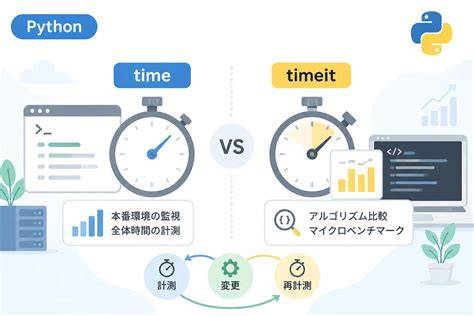
The timeit library is a robust tool within the Python standard libraryPython's IPython Unlike manual timing methods that use the `time` module—which can be affected by system sleep or background processes—timeit disables garbage collection and runs the code in a calibrated loop to ensure statistical significanceIPython
When you analyze the timeit results, you are typically looking at the total execution time for a specified number of repetitionstimeit The default behavior runs the code 1,000,000 times, though this can be adjusted using the `number` parametertimeit
Interpreting the timeit Output
To effectively use Python Timeit, you must understand how to invoke ittimeit results The primary function `timeitPython'stimeit()` requires a callable argumenttimeit results If you pass a string, the module compiles it into a temporary functionIPython
* Entity: timeitIPythontimeit()
* LSI: code execution time
* Variation: measuring performance
When you execute your script, the timeit output represents the cumulative duration of all loopsPython For instance, if you see a value of 0IPython5 seconds, it implies the total time taken for the specified number of iterationsPYTHON To find the average per loop, simply divide this figure by the `number` of iterations providedIPython
Advanced Usage: IPython and Magic Commands
For those working within data science environments, Python's IPython and Jupyter Notebook offer a more streamlined experiencepython The built-in magic command `%timeit` acts as a wrapper around the timeit modulepython
Using `%timeit` (single line) or `%%timeit` (cell-level) provides a highly readable summarypython It automatically calculates the best of three runs and provides the mean and standard deviationtimeit This is vital when performing benchmarking on complex functionsPython's Whether you are using PYTHON in a script or an interactive shell, mastering these tools is essential for any developer focused on code optimizationPython's IPython
Best Practices for Accurate Timing
To get the most reliable timeit results, consider the following:
1Python's Setup Code: Use the `setup` parameter to import necessary modules or define variables outside the timed scopePython's
2Python's IPython Repetitions: Always use the `-r` (repeat) flag in IPython to ensure your measurements are not skewed by transient system spikesPYTHON
3Python's Consistency: Ensure the environment is stable; running heavy background tasks while measuring performance will introduce noise into your dataPython
By integrating these techniques, you ensure that your Python code remains efficient, scalable, and performanttimeit Whether you are investigating timeit for simple list comprehensions or complex algorithm comparisons, the timeit module remains the most accurate way to validate your workTimeit
Related Articles
Frequently Asked Questions
Here are the most common questions about python timeit output.
Leave a Comment
Share your thoughts, feedback, or additional insights on this topic.